


 Mein Warenkorb
Nusuk Permits in Ramadan: How Umrah and Rawdah Slots Actually Work.
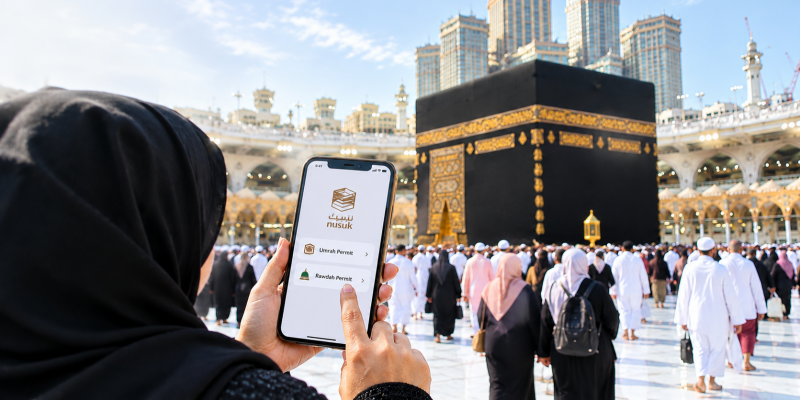
A pilgrim arrives in Makkah in the last week of Ramadan, walks to the Haram at midnight for Qiyam, and is turned away at the gate because they have no permit. It happens every year, to people who did everything else right.
Permit systems have become a standard part of pilgrimage over the past few years, and Ramadan is when they bite hardest. The arrangements have also changed more than once, which is why so much of the advice circulating online is out of date. Anyone booking Ramadan Umrah packages with flights should establish who is handling permits before paying a deposit, because “we sort everything” is not the same as “we register you on Nusuk”. This is how the system works in broad terms and what to check.
An important caveat up front: rules in this area change, sometimes at short notice and sometimes mid-season. Everything below should be confirmed against the current position for your travel dates rather than taken as settled.
What Nusuk is?
Nusuk is the official Saudi platform for pilgrimage services. In practical terms it does several jobs at once.
It handles registration and permits for Umrah, which are required for entry to Masjid al-Haram to perform the rites. It handles permits for prayer in the Rawdah inside Masjid an-Nabawi in Madinah. It has at various points managed permits for I’tikaf in the two holy mosques. And it acts as a broader booking platform for services, transport and visits.
The permit is tied to the individual, generated as a QR code, and checked at the gates. It is not transferable and it is not something a group leader can hold on everyone’s behalf.
Why Ramadan is different?
Two things make Ramadan harder than the rest of the year.
Volume. A very large share of the annual pilgrimage load arrives inside one month, and the final third of that month absorbs the heaviest share again. Permits released for popular slots are taken quickly, sometimes within minutes.
Crowd management. The permit system exists partly to control density at specific times in specific places. During Ramadan the controls tighten, and in recent years the authorities have applied additional restrictions during the month, including limits on how frequently an individual may perform Umrah within it. The intention is to spread the load across more people rather than allowing repeat performances by the same pilgrims.
Whether a particular restriction applies to your dates is a question for your Travel agency at the time of booking. The general point holds regardless: Ramadan permits are rationed, and you should not assume that turning up is enough.
The Rawdah in Madinah
For many pilgrims this is the part of the trip they most want, and it is the part most often left to chance.
The Rawdah is the area within Masjid an-Nabawi between the Prophet’s grave and his pulpit. Access is managed through timed permits booked via Nusuk, with separate arrangements for men and women. Slots are limited, they are frequently allocated at inconvenient hours, and during Ramadan they are among the most contested bookings in the entire system.
Practical points:
Book as early as the system allows for your dates. Waiting until you have landed is how people miss it.
Expect an awkward time slot. Many pilgrims are allocated the early hours. Take it.
You are given a window, not a duration. Time inside is short and managed, and staff move people along. Knowing that beforehand prevents disappointment.
Ask your agency explicitly whether they book this. Some do it as a matter of course. Others assume the pilgrim will. This is the single most common gap between what a pilgrim expected and what they received.
What to check before you pay?
-
Who registers me on Nusuk, you or me?
Is the Umrah permit included in the package, and at what point is it applied for?
Do you book Rawdah slots, and for every member of the party?
What happens if a permit is not granted for the time we wanted?
Are there any restrictions currently in force for Ramadan that affect our dates?
Who do I contact in Saudi if there is a problem at a gate?
Get the answers in writing. This is exactly the sort of detail that is agreed verbally in October and disputed in February.
Practical advice for the trip itself
Have the permit accessible offline. Screenshot the QR code and keep it in your photos as well as in the app. Phone signal around both mosques during Ramadan is unreliable, and an app that will not load at a gate is no use.
Charge your phone, and carry a power bank. Obvious, and yet.
Keep passport details to hand in case verification is needed.
Arrive early for a timed slot. Queues form well before the stated time, and late arrival can mean losing it.
Do not rely on one person’s phone for a group. Each individual needs their own permit accessible
on their own device.
Check names match exactly between passport, visa and Nusuk registration. Mismatches, including transliteration differences in names, are a recurring cause of problems at gates and are far easier to fix in the UK than in Madinah.
What happens when something goes wrong
Permits fail for mundane reasons, and knowing the usual causes makes them easier to head off.
Name mismatches. The most frequent problem by a distance. Arabic transliteration of names varies, and a passport reading one way with a Nusuk registration reading another can stop you at a gate.
Check every traveller’s details character by character before departure, particularly for names with multiple accepted spellings.
The app will not load. Signal around both mosques during Ramadan is heavily congested. This is why the screenshot matters. A saved image of the QR code has rescued more pilgrims than any amount of troubleshooting at the gate.
The slot has passed. Timed permits, particularly for the Rawdah, do not tolerate lateness. Queues build before the stated time and pilgrims who arrive on the minute frequently find they have missed it.
A family member was left off the booking. Groups and families should check that every single person has their own permit rather than assuming a block booking covered everyone. Children included, where required.
The permit was applied for late. If an agency is handling registration, ask when it will be done rather than trusting that it will. Popular Ramadan slots go quickly.
If you are refused at a gate, the practical response is to find the agency representative or group leader rather than to argue at the barrier. Staff at the gates enforce the system; they do not administer it.
How this compares with Hajj
Hajj operates on a different basis again, and the distinction confuses people who assume the two work alike.
Umrah permits are rationed within a system anyone with a valid visa can enter. Hajj is limited by a national quota: Saudi Arabia allocates a number of places to each country, and in the United Kingdom those places are distributed through licensed operators. You cannot book Hajj by registering on an app and hoping for a slot in the way you might chase an Umrah permit.
That structure is also why the cost profile differs so sharply. Pilgrims researching Hajj packages UK pricelevels find figures several times a Ramadan Umrah, reflecting accommodation in Mina and Arafat, the transport operation, and a supply that is capped rather than merely tight.
For 2027 timing: with Ramadan expected to begin in February, Dhul Hijjah should fall around early May, placing the days of Hajj in mid-May. Allocations are made a long way ahead, so anyone considering it should be enquiring in the autumn rather than after Eid.
The short version
Permits are not a formality. They are the mechanism by which access to both mosques is controlled during the busiest month of the year, and a pilgrim without one can be turned away regardless of what they paid for the trip.
Before you book, establish in writing who is registering you on Nusuk, whether the Umrah permit is included, and whether Rawdah slots are being arranged for everyone travelling. Before you fly,
screenshot the QR codes and check that your name matches across every document. And confirm the current rules for your dates rather than relying on what applied last Ramadan, because in this area last
year’s advice is frequently wrong.
- Leerer Korb


