


 Mon Panier
A Journey Through the Heart of the Moroccan Sahara
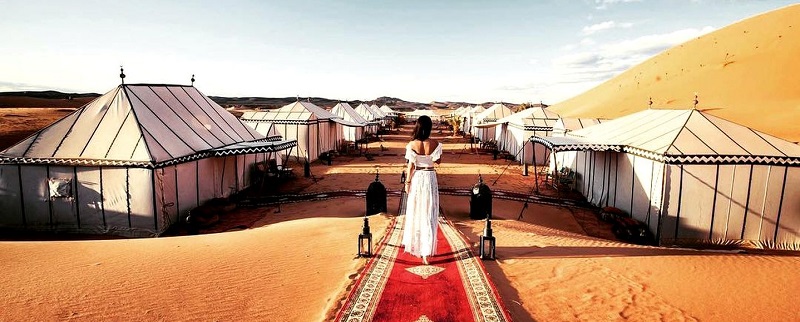
Embarking on a journey from the vibrant, ochre-tinted streets of Marrakech toward the vast, silent stretches of the Moroccan Sahara is more than just a road trip; it is a pilgrimage into the soul of North Africa. This “Full Southern Circle” represents the ultimate Moroccan odyssey, a loop that stitches together the high peaks of the Atlas, the lush greenery of hidden oases, and the majestic, shifting gold of the dunes. To travel this route is to witness a dramatic transformation of landscape and spirit, moving from the chaotic energy of the Jemaa el-Fnaa to the profound, starlit silence of the deep desert.
Crossing the Spine of the Atlas: Tizi n’Tichka
The adventure begins with an ascent. Leaving Marrakech, the road winds upward into the High Atlas Mountains, navigating the legendary Tizi n’Tichka pass. Reaching an elevation of 2,260 meters, this is the highest paved mountain pass in North Africa. The drive is a masterclass in geological drama; around every hairpin turn, the scenery shifts from Mediterranean scrub to jagged, snow-capped peaks and deep, terracotta-colored valleys. The air grows crisp, and the scale of the landscape serves as a humbling introduction to the wildness that lies ahead. This pass is the gateway, the physical and symbolic threshold between the bustling imperial north and the tribal, nomadic south.
The Clay Sentinels: Ait Ben Haddou and Ouarzazate
As the descent begins, the landscape flattens into a sun-baked plateau where the architecture shifts from concrete to sun-dried mud brick. The first major jewel on this crown is Ait Ben Haddou. A UNESCO World Heritage site, this ksar (fortified village) is a striking example of southern Moroccan earthen architecture. Looming over the Ounila River, its towers and crenellations seem to grow directly out of the mountainside. Walking through its narrow, uphill alleys is like stepping back into the era of the trans-Saharan trade caravans. It is no wonder that Hollywood has claimed this site for decades, using it as the backdrop for epics like Gladiator and Game of Thrones.
A short drive further brings you to Ouarzazate, known as the “Hollywood of Africa.” While it serves as a modern administrative hub, its heart remains in the Atlas Studios and the magnificent Taourirt Kasbah. Ouarzazate is where the desert begins to exert its influence; the light here has a crystalline quality that has fascinated cinematographers for a century. It acts as the final outpost of urbanity before the road branches off into the valleys of the Draa and the Dades.
The Valleys of Life: Dades and Todgha Gorges
Turning eastward, the route follows the “Road of a Thousand Kasbahs.” The Dades Valley offers a surreal landscape of “monkey fingers” rock formations—limestone cliffs eroded into smooth, tubular shapes that look almost extraterrestrial. The Dades Gorges themselves are a marvel of engineering and nature, where the road zig-zags up steep canyon walls, offering dizzying views of the green ribbon of palms following the riverbed below. It is a place of cool breezes and rose-scented air, especially near M’Gouna, where millions of damask roses bloom every spring.
Continuing the loop, one encounters the Todgha Gorges. If Dades is about winding elegance, Todgha is about sheer, vertical power. The canyon walls here rise 300 meters straight up, leaving only a narrow path for the crystalline river and the travelers walking beside it. The scale is immense, creating a natural cathedral of orange limestone. It is a sanctuary for climbers and a vital water source for the local Berber communities who have farmed these palm groves for generations.
Into the Deep Sand: Erfoud and the Magic of Merzouga
The landscape begins to surrender its greenery as you approach Erfoud. Known as the gateway to the desert, Erfoud is famous for its fossils—remnants of a prehistoric ocean that once covered this land. The black marble quarried here, filled with ancient trilobites and orthoceras, is a reminder of the Earth’s vast timeline. But Erfoud is merely the preamble to the main event: Merzouga.
At Merzouga, the world changes. The Erg Chebbi dunes rise like frozen waves of orange silk, some reaching heights of 150 meters. Arriving here at the golden hour is a transformative experience. As you swap four wheels for a camel caravan, the silence becomes absolute. The trek into the dunes as the sun dips below the horizon—painting the sand in hues of violet, crimson, and copper—is the quintessential Saharan moment. Spending a night in a traditional Berber camp under a canopy of stars so bright they feel within reach is the climax of the Southern Circle. Here, time ceases to exist, replaced by the rhythmic pulse of the desert night.
The Draa Valley and the Spirit of Zagora
The journey then pivots back toward the west, heading toward Zagora via the rugged Alnif and Tazzarine plains. This stretch of the journey feels like a true expedition, crossing “hamada” (stony desert) that feels infinite. Zagora itself is steeped in history, famously marked by the iconic sign “Timbuktu 52 days.” It was a vital stop for caravans carrying salt, gold, and spices across the Sahara.
The Draa Valley, stretching from Zagora back toward Ouarzazate, is a lush miracle. It is home to Morocco’s largest palm grove, a dense forest of date palms that stretches for nearly 200 kilometers. Traveling through the Draa is a lesson in the “Palmeraie” ecosystem—a three-tiered garden of palms, fruit trees, and vegetables, all fed by ancient irrigation systems. The earthen villages (ksours) along this route, such as Tamnougalt, offer a glimpse into a way of life that has remained largely unchanged for centuries.
The Return to the Red City
The circle begins to close as you pass back through Ouarzazate and over the Tizi n’Tichka once more. The descent back into Marrakech feels like returning from another planet. The neon lights and motorbikes of the city are a sharp contrast to the starlit dunes of Merzouga and the quiet palm groves of Tinghir. However, you return with more than just photographs; you return with the “Sahara in your shoes”—a local metaphor for the lingering soul of the desert.
This Full Southern Circle is not just a tour; it is an immersion into the diverse textures of Morocco. It is the contrast between the vertical walls of Todgha and the horizontal infinity of the Erg Chebbi. It is the transition from the snowy Atlas to the burning sands of the south. For those seeking the “best of the Sahara,” this route offers a complete narrative of the land, its people, and its timeless beauty.
Keywords: Moroccan Sahara Tour, Marrakech to Merzouga, Tizi n’Tichka Pass, Ait Ben Haddou Kasbah, Ouarzazate Film Studios, Dades Gorges, Todgha Canyon, Erg Chebbi Dunes, Zagora Desert, Draa Valley Palms, Berber Culture, Saharan Camel Trek, Southern Morocco Road Trip.
- Panier vide


